Gospel Impact Metric · Nationwide coverage

Your tract deserves
more than instinct.
Give it a field report.

We can’t measure the invisible miracle. We can watch its ripples. Most churches are making neighborhood decisions — where to plant, where to invest, where to stay — without anything to watch. This is the instrument panel for what follows from Gospel fruit.

Field readiness scoreGospel Impact over time trendlinesLifeMode mix + pressure

From your address to a pastoral report in three moves.

01

Run the field diagnostic

Verify an address, answer a dozen gospel-impact prompts, and we pull the tract’s shalom, Gospel Impact over time, and needs data from the national store.

02

See the map + Gospel Impact over time pillars

You immediately get the nationwide map plus a Field Readiness Score, tract percentile, and Gospel Impact over time mix so you can compare your tract to county peers.

03

Read the pastoral report

Download the Local Area Gospel Impact Metrics PDF: tract dossier, map card, Field Readiness Score, Gospel Impact over time deck, LifeMode mix, and gospel pressure notes.

I did not build this tool because I saw a market gap. I spent three years doing incarnational mercy ministry in public housing and among the unhoused in Anne Arundel County—before I built a single framework, wrote a single line of code, or drew a single chart.

My background is a strange combination for this work: a B.S. from the United States Naval Academy, several years writing production software at Northrop Grumman, an M.A. in Journalism from the University of Maryland, and an M.Div. from Westminster Theological Seminary.

The engineering rigor, the reporter’s instinct to follow evidence, and the theological discipline to ask what it means—The Hood Shepherd is what happens when those converge with three years on the street.

I did not hire someone to build this. I built it. That matters more than the methodology.

Before the elder meeting. Not after.

A church planter working in a high-distress Baltimore neighborhood had a problem. He knew something was moving — relationships forming, households opening, quiet signs of fruit — but he had no way to show his elders. He needed to demonstrate directional progress before asking them for a three-year ministry commitment.

He ran a Field Diagnostic on his tract. The reconciliation domain was climbing. Social capital was compounding. Hospitality indicators were trending in the right direction. He brought the domain scores to the meeting with trend arrows and pastoral interpretation already attached.

The elders approved the commitment.

That’s the use case. Not a research project. Not a grant report. A pastor who needed to see clearly — and then needed to show others what he saw.

Run a Field Diagnostic for Your Neighborhood →

The map is free. Search any tract.

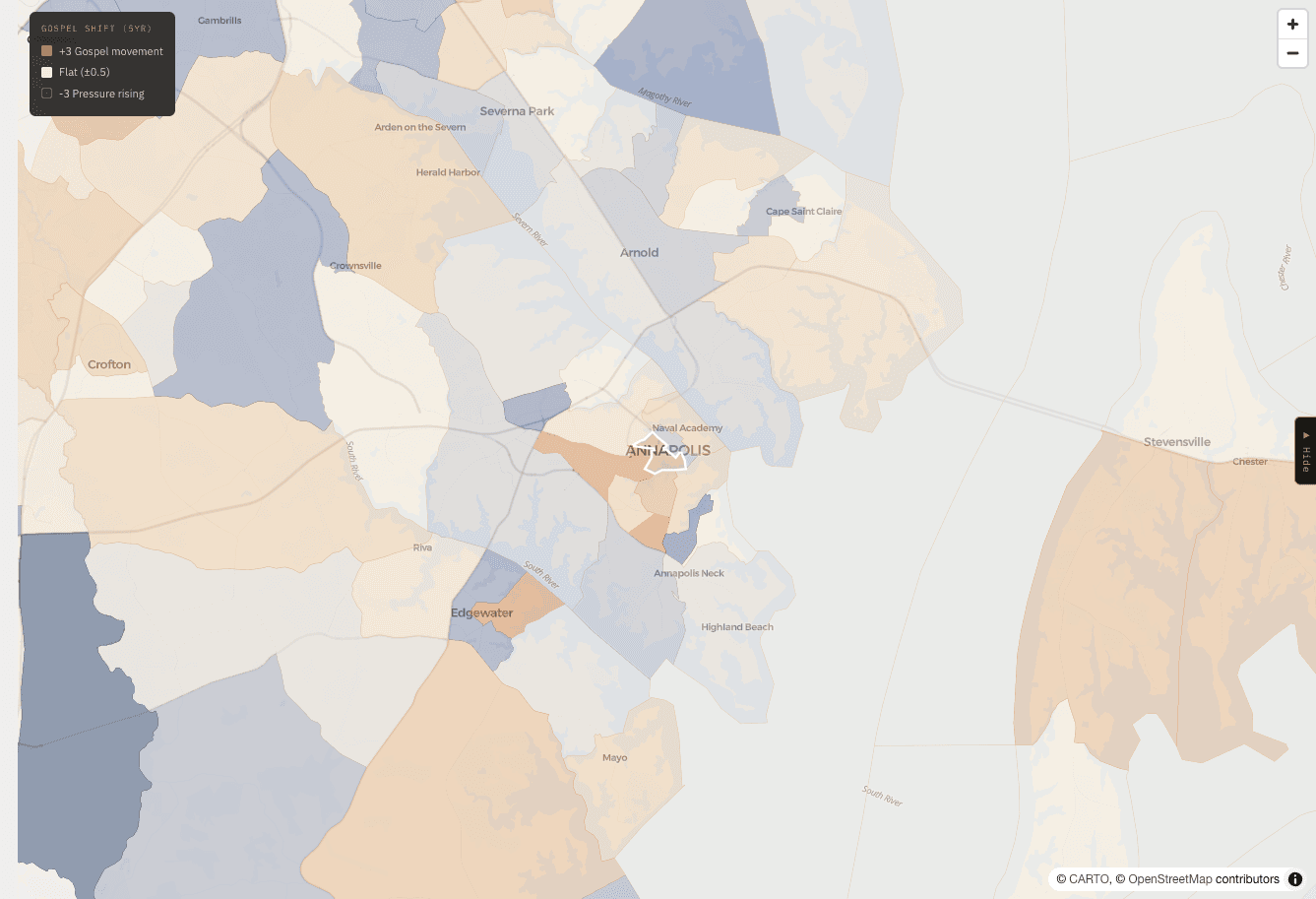
Search any address in the country. The map shows composite neighborhood pressure — where love would be especially good news. Tap any tract to see its score, Gospel Impact over time mix, and how it sits against county peers. The summary stays pinned as you explore.

  • Baseline-normalized scores show pressure, not just affluence.
  • County percentile exposes where love would be especially good news.
  • Change-since-2020 layer arrives once dual-year caches finish.
Run a Field Diagnostic →
-10 or less-4Flat+4+10 or more

-10 or less

-4

Flat

+4

+10 or more

Change vs 2020 composite (amber = Gospel movement, navy = pressure rising; scaled ±10 pts).

Zoom anywhere in the U.S. and tap a tract.

These calculations show pressure or lift in the tract-level blend of safety, housing, health, and reconciliation conditions that tend to shift when the Gospel takes root. Correlation to ministry impact still requires local church diagnostics (see the Field Diagnostic package).

Select a tract to see its Gospel Impact breakdown.

Local Area Gospel Impact Metrics — the tract dossier pastors hand to elders.

Every PDF opens with the selected tract, map tile, and parcel provenance. Then comes the Field Readiness Score, Gospel Impact over time deck, LifeMode mix vs county baseline, gospel-pressure alignment notes, and a sealed appendix of your survey responses.

Field Readiness Score

85High

County percentile + need level that frames the entire tract briefing.

Composite vs 2020

54+1

Baseline-normalized composite with the year-over-year delta right on the card.

Living Pillar

54+1

Hospitality, stability, and belonging indicators packaged as a single pillar.

Hope Pillar

32+6

Pressure + recovery signals so you can name why ministry presence matters.

The questions practitioners ask before they buy.

Is this measuring conversions?+

No. Regeneration is God’s work. The metric looks for the neighborhood-level ripples Scripture says often accompany Gospel fruit — hospitality, reconciliation, mercy, credibility, endurance.

What exactly do I receive?+

A Local Area Gospel Impact Metrics PDF: tract dossier + parcel metadata, Field Readiness Score with need level, Gospel Impact over time cards, top LifeModes vs county baseline, gospel-pressure alignment notes, and an appendix of your survey responses. It is laid out so elders, funders, or civic partners can read it cold.

How often is the data refreshed?+

The national tract store is updated continuously. Scores are normalized to each tract’s baseline, so you see direction and pressure — not just raw affluence.

Can I preview before paying?+

Yes. The nationwide map is free to explore — no account required. Anne Arundel County residents can request a complimentary full diagnostic. Everyone else can purchase a tract-level report instantly and receive it the same session.

2 Corinthians 4:7

“We have this treasure in jars of clay, to show that the surpassing power belongs to God and not to us.”

The Gospel Impact Metric is a jar of clay. Use it to see more clearly. Let it push you toward the street, not away from it. And never let the score replace the face of the neighbor you are called to love.